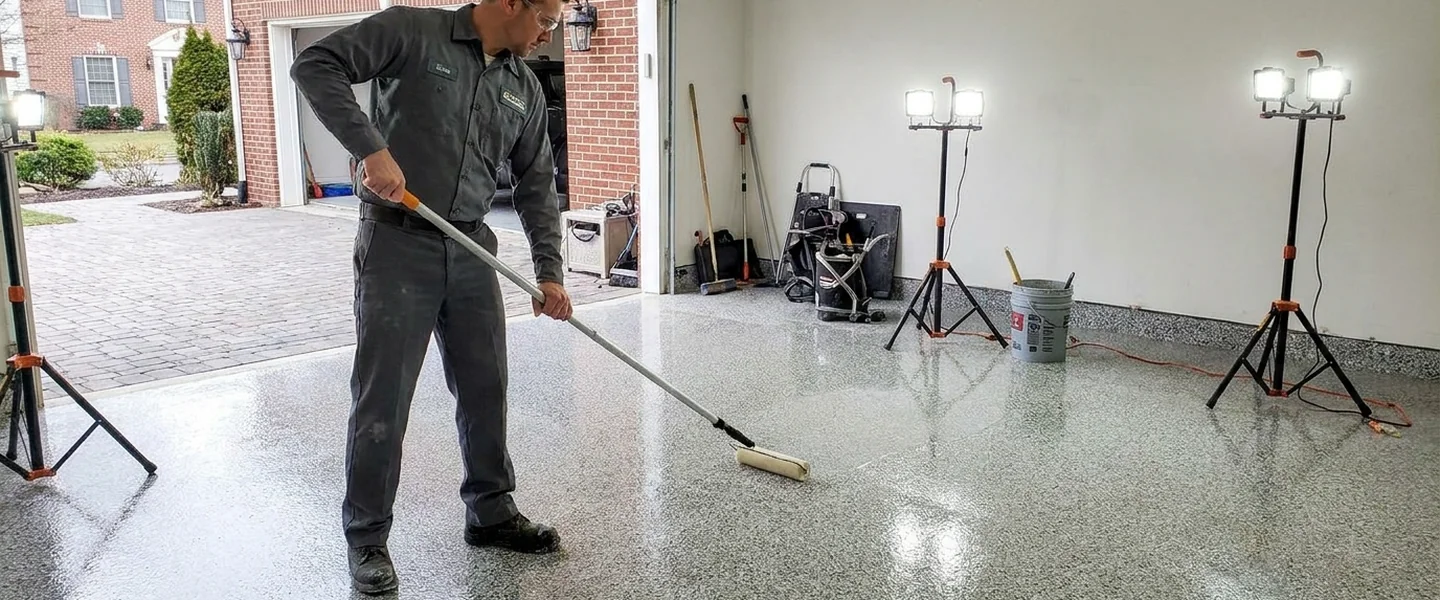
Polyaspartic Floor Coating in Philadelphia, Pennsylvania
Same-day-cure polyaspartic floor coating — park on it within 24 hours. Built for Philly homeowners who can’t take their garage offline for a week.
- Licensed & Insured in Pennsylvania
- Locally Owned, Philadelphia-Based
- 15-Year Polyaspartic Topcoat Warranty
- Free On-Site Estimates
- 0% Financing Available
What Polyaspartic Floor Coating Means in Philadelphia, PA
Polyaspartic floor coating is a fast-cure, UV-stable, chemically-bonded floor system installed in a single day, allowing return to vehicle traffic within 24 hours. The polyaspartic chemistry is a derivative of polyurea, modified for predictable working time and color stability. In the Philadelphia climate, it is the right answer for homeowners who can’t take their garage offline for a week and for time-sensitive commercial reopens. Performance matches or exceeds epoxy-polyaspartic hybrid systems when the prep is done right.
The Philadelphia metro’s specific climate makes this work especially impactful. We see homeowners in Cherry Hill, King of Prussia, Conshohocken, Media, Bensalem, Doylestown, Levittown, and Norristown go from pitted, dusty, salt-damaged concrete to a finished floor that handles winter brine, hot-tire contact, and decades of use within a few days of the install. The before/after photos tell the story — most Philadelphia slabs start with active surface degradation and finish with a clean, sealed, professional finish ready for vehicle traffic within 24-48 hours.
Project Details
| Service Area | Philadelphia, PA plus Cherry Hill (NJ), King of Prussia, Conshohocken, Media, Bensalem, Doylestown, Levittown, Norristown |
|---|---|
| Install Days | 1 day (depending on slab condition, square footage, and chosen finish) |
| Materials Used | PolyTek, Wolverine, Penntek, and Citadel coating systems; Torginol vinyl flake; polyurea crack-injection; vapor-block primers as needed |
| Warranty | 15-year manufacturer warranty on polyaspartic topcoat; 5-year transferable workmanship warranty |
| Crew Size | 2-3 installers, including the installer who did your inspection |
| Permit Required | No — residential garage and basement floor coatings do not require permits in the Philadelphia metro |
| Investment | Quoted per job after a free on-site inspection — every estimate is itemized in writing |
Our Process
Every polyaspartic floor coating job in the Philadelphia metro follows the same disciplined sequence. We do not skip diamond grinding because of scheduling pressure, and we do not bid jobs that require shortcuts.
Step 1: Pre-install inspection
Moisture readings, photographs, crack and repair scope, and a frank conversation about whether polyaspartic-only or epoxy-polyaspartic hybrid is the right system for your slab and use case.
Step 2: Slab repair
Polyurea crack injection on active cracks; epoxy mortar patch on pits and divots. Repairs must be fully cured before grinding.
Step 3: Diamond grinding
Same CSP 2-3 profile as our epoxy-polyaspartic system. Polyaspartic on a poorly prepped slab fails faster than epoxy does — the prep is non-negotiable.
Step 4: HEPA vacuum and detail
Every square foot is vacuumed; wall edges and posts are hand-detailed.
Step 5: Polyaspartic basecoat
A pigmented or clear polyaspartic basecoat is rolled at 6-10 mils with the working time set by the formulator’s catalyst load for the day’s conditions.
Step 6: Flake broadcast (optional)
If a flake finish is selected, vinyl flake is broadcast into the wet basecoat. Polyaspartic basecoats grab flake faster than epoxy, so the broadcast is timed to the formulator’s data sheet.
Step 7: Polyaspartic topcoat
One or two topcoats of UV-stable polyaspartic are rolled within the recoat window. The final coat carries the slip-resistance aggregate.
Step 8: 24-hour return to service
Manufacturer-specified return-to-vehicle-traffic time is typically 24 hours after the final coat. We photograph the finished install and walk you through care.
Materials We Use
We are loyal to materials that perform in the Delaware Valley climate. The list is short and intentional:
| Epoxy Basecoat | PolyTek, Wolverine Coatings, or Citadel 100% solids epoxy (selected for slab condition) |
|---|---|
| Polyaspartic Topcoat | PolyTek 5811 / Wolverine Polyaspartic 750 — UV-stable, chemical-resistant, rated for hot-tire contact |
| Vinyl Flake | Torginol or Penntek decorative flake, broadcast to refusal |
| Vapor-Block Primer | Two-component epoxy MVT primer for basement and slab-on-grade installs over high-emission concrete |
| Slip-Resistance Aggregate | Aluminum oxide or polymer bead, broadcast into the final topcoat at engineered density |
Common Scenarios We See in Philadelphia Garages
The 1950s Levittown Single-Bay
Original Levitt-era 3-4 inch slab, no rebar, no vapor barrier, active hairline cracks expanding annually with freeze-thaw cycling. Solution: polyurea crack injection, self-leveling underlayment as needed, full diamond grind, then a flake-and-polyaspartic system that bridges minor movement.
The Cherry Hill Detached Garage
1960s-1970s detached two-car structure with heavy salt pitting and tire-drip damage at the wheel-well zones. Solution: surface patch, full grind, full broadcast flake, and a polyaspartic topcoat rated for sodium-chloride and calcium-chloride exposure.
The Norristown Row-Home Garage
Pre-1940s slab with severe surface spalling, aggregate exposed, and a damp basement adjacent. Solution: extensive concrete repair, vapor-block primer to deal with the moisture migration from the adjacent basement, then a moisture-tolerant coating system.
The Doylestown Estate Bay
2010s four-car attached garage in excellent slab condition, homeowner wants a showroom-grade finish. Solution: metallic epoxy basecoat with custom color blend, two coats of clear polyaspartic, slip-resistance broadcast in the final coat. Garage doubles as hobby and gym space.
Why Philadelphia Homes Need This Service
The Philadelphia metro sits in a climate that punishes uncoated concrete in two specific ways: salt-and-brine corrosion from aggressive winter de-icing, and freeze-thaw cycling that opens hairline cracks and breaks the bond between aggregate and cement paste. Add the prevalence of pre-1990 housing stock with non-engineered slabs (Levittown, parts of Norristown, older Bensalem) and the row-home and twin layouts where garage and basement floors share moisture realities, and the case for a properly engineered coating system becomes self-evident. Polyaspartic Floor Coating addresses every one of those problems with a single integrated install.
Warranty in Detail
Our warranty has three components, and we want you to understand each before you sign anything:
Manufacturer materials warranty. PolyTek and Wolverine Coatings polyaspartic topcoats carry a 15-year manufacturer warranty against material defects including UV color shift, blistering, and chemical degradation under specified use conditions. Epoxy basecoats carry their own manufacturer warranties (typically 5-10 years) and the vinyl flake carries a colorfastness warranty.
Workmanship warranty. We warrant our installation work for 5 years and that warranty is transferable to a new homeowner. The transfer is paperwork only — we don’t charge a transfer fee. We’ve had warranty calls; we have always honored them. Every install is photographed at completion so there is no dispute about what was installed where.
What’s explicitly NOT covered. Damage from chemicals outside the specified use case (e.g., spilled battery acid, brake cleaner solvents at high concentration without prompt cleanup). Damage from impact (dropped wrenches will chip a 25-mil coating). Damage from coatings or sealants applied by other parties over our system without our review. We tell you these up front because we’d rather lose a sale than have a warranty dispute later. Most national franchises bury these exclusions in fine print; ours is in the written estimate in plain English.
How We Quote (Without Quoting on the Phone)
We do not quote polyaspartic floor coating over the phone. We’ve tried, and the resulting numbers were almost always wrong — sometimes too high, sometimes too low, and always frustrating for the homeowner who got a different number from the installer on inspection day. So we don’t do it. Instead, we schedule a free 30-minute on-site inspection within 48 hours, walk the slab, take moisture readings, photograph conditions, and deliver a written itemized estimate within 24 hours of the visit. The estimate spells out every component, every material brand and product, every linear foot of repair scope, the day-by-day timeline, and the warranty terms. You take it home and decide on your own time. No follow-up call, no “expiring tonight” discount, no pressure. If the price is acceptable, you sign and schedule. If it isn’t, no hard feelings.
After the Install
We follow up at 30 days on every polyaspartic floor coating job in the Philadelphia metro. The 30-day check verifies the coating is performing — no edge curl, no blistering, no early indication of moisture pushback — and answers any homeowner questions about care, snow removal, and what cleaning chemicals to use or avoid. The check is included in the original quoted price. If anything seems off in between — a chip you can’t explain, a spot where snow seems to bead differently, anything — call us. The same installer who did your install handles the call.
Service Areas
We perform polyaspartic floor coating across Philadelphia and these surrounding suburbs: Cherry Hill, King of Prussia, Conshohocken, Media, Bensalem, Doylestown, Levittown, Norristown.
Frequently Asked Questions
How long does polyaspartic floor coating take in Philadelphia?
For a typical residential garage in the Philadelphia metro, this service takes 1 day on site. The exact timeline depends on slab condition, square footage, and the chosen finish. We give you a day-by-day schedule with the written quote and stick to it.
Do I need to be home during the install?
We need access to the slab and any electrical outlets we’ll use, but you don’t need to be home for the full duration. We do need you home for the initial walk-through and the final walk-through, both of which take 15-30 minutes.
Is the warranty transferable?
Yes. Manufacturer warranty on the polyaspartic topcoat (15 years for our standard PolyTek and Wolverine systems) plus a 5-year transferable workmanship warranty on the install. Transfer to a new homeowner is paperwork only — no fee.
Will this work on older Philadelphia garage slabs?
Yes — the older slabs are where this work has the biggest impact, but they also require the most prep. Pre-1990 slabs in Levittown, Norristown, and the older sections of Bensalem typically need crack repair and surface paste re-establishment before coating. We include that scope when present rather than skipping it.
Will hot tires lift the coating?
Not on a properly prepped polyaspartic system. Hot-tire pickup is a chemistry-and-prep failure, not a fundamental limitation of epoxy or polyaspartic coatings. We diamond-grind every job for chemical bond, use a polyaspartic topcoat rated for thermal cycling, and have never had a callback for tire lift in a properly prepped install.
Can you epoxy a floor in winter?
Yes. Polyaspartic and epoxy chemistry continue to cure at temperatures down to about 35-40°F on the slab, and we monitor concrete temperature with an infrared thermometer at every install. Philadelphia-area winter installs are routine. We schedule heated cure tents for the coldest days when needed.
How long until I can park on the floor?
For polyaspartic-only systems: 24 hours after the final coat. For full epoxy-polyaspartic systems: 24-48 hours typically. For metallic epoxy with polyaspartic topcoat: 48-72 hours. Foot traffic is usually safe within 12-24 hours of the final coat. Specific return times are written into the quote based on the system you choose.
Is the floor slippery when wet?
Slip resistance is engineered, not assumed. Every install includes a slip-resistance aggregate broadcast into the final coat sized to the use case — moderate for residential garages, heavier for commercial and basement installs. The finished floor meets or exceeds ANSI/NFSI safety thresholds for the application.
Will the coating handle Philly road salt?
Yes — that’s exactly what a polyaspartic topcoat is built for. UV-stable, chemical-resistant, and rated for sodium-chloride and calcium-chloride exposure. We use systems engineered specifically for Northeast and Mid-Atlantic winter conditions.
What if I find something wrong after the install?
Call us. The same installer who did your install handles the follow-up. We do a 30-day check on every job, included in the quoted price. If something is genuinely defective, the warranty covers it; we don’t argue over warranty claims.
Why no price on the website?
Because every Philadelphia garage is different and a phone quote would be wrong. We give you a written, itemized estimate after a free 30-minute on-site inspection. That estimate is the real number — not a ‘starting at’ bait price.
Service Areas We Cover
We serve Philadelphia and the entire metro area on both sides of the Delaware River. Click your suburb for local details and the conditions we typically find in your housing stock:
Get a Free Quote for Polyaspartic Floor Coating
Same-week appointments. No high-pressure sales. Serving Philadelphia and surrounding areas including Cherry Hill, King of Prussia, Conshohocken, Media, Bensalem, Doylestown, Levittown, Norristown.
What You Get in Our Quote vs. the Lowball Bid
We don’t compete on the lowest sticker price — we compete on the quote that gets the job actually done. Here is what is included in every quote we write, and the cut-corners that show up in cheaper bids.
Included in our written quote
- Concrete moisture + porosity testing
- Crack and pitting repair before coating
- Full diamond-grind surface prep
- Written quote with flake/coat specs
- Cure-time schedule you can plan around
- 5-year warranty against delamination
Cut corners in the lowball bid
- Coating over uncured or wet slab
- Roller-only prep (no diamond grind)
- Lowball quotes without crack repair
- Subbed-out installation
- No moisture testing before coat
- Warranties full of fine print