Moisture Vapor Emission: The Silent Killer of Philadelphia Garage Floors
Locally based epoxy floor specialists serving the Philadelphia metro since 2019.
- Licensed & Insured in Pennsylvania
- Locally Owned, Philadelphia-Based
- 15-Year Polyaspartic Topcoat Warranty
- Free On-Site Estimates
- 0% Financing Available
Moisture vapor emission is the most under-discussed failure mode for garage and basement floor coatings in the Philadelphia metro. It’s also the most preventable. Homeowners who get a coating installed without first testing for moisture vapor emission rate (MVER) are betting against a process that’s happening 24 hours a day in their slab — and in row-home basements and pre-1980 slab-on-grade garages, that bet usually loses within a year. This post explains what moisture vapor emission is, why it kills coatings, why it’s specifically bad in Philadelphia-area homes, and how to test for and address it before any coating goes down.
What Moisture Vapor Emission Is
Concrete is permeable. Water from the soil below the slab migrates upward through the capillary pores in the cement matrix and emits as vapor at the surface. The rate of emission is measured in pounds per 1,000 square feet per 24 hours (lb/MSF/24hr) by the calcium chloride test (ASTM F1869) or as relative humidity percentage by in-situ probe (ASTM F2170). Healthy slabs with a working under-slab vapor barrier emit at low rates that most coatings can tolerate. Slabs without an under-slab vapor barrier, or with a failed one, emit at rates that exceed coating tolerances and cause failure.
Why Philadelphia-Area Slabs Are Worse
Three factors combine to make Philadelphia a moisture-vapor-emission city for coatings work:
Under-slab vapor barriers are uncommon in older construction. Pre-1980 residential slabs were poured directly on graded soil with no vapor barrier. Today’s IRC R506.2.3 requires a barrier on slab-on-grade construction in habitable spaces, but the requirement is enforced inconsistently for garages and basements and didn’t exist in 1955 when most Levittown slabs were poured.
Row-home and twin basements sit directly on Pennsylvania clay or fill. The slab is essentially a permeable lid over a constant source of soil moisture. Without a working vapor barrier, the emission rate is essentially the rate at which soil moisture can pass through the cement matrix.
Spring water-table rises drive sustained high emission. Philadelphia-area soil moisture peaks in March-May after winter snowmelt and spring rain. Slabs that test acceptable in October can fail a test in April. Honest moisture testing accounts for seasonal variation.
What Moisture Vapor Emission Does to a Coating
The emission rate matters because the coating, once applied, is a barrier on top of the slab. Vapor that was emitting freely now hits the underside of the coating and builds pressure. When the pressure exceeds the bond strength between coating and slab, the coating lifts off the slab in blisters or full delamination. The blisters can be the size of a coin or the size of a dinner plate; the underlying cause is the same. Adhesion is the casualty, and once a coating has blistered there is no patch — the failed area has to come off, the slab has to be retested and treated with a vapor-block primer, and a new system has to be installed.
How to Test
Two industry-standard tests measure moisture vapor emission:
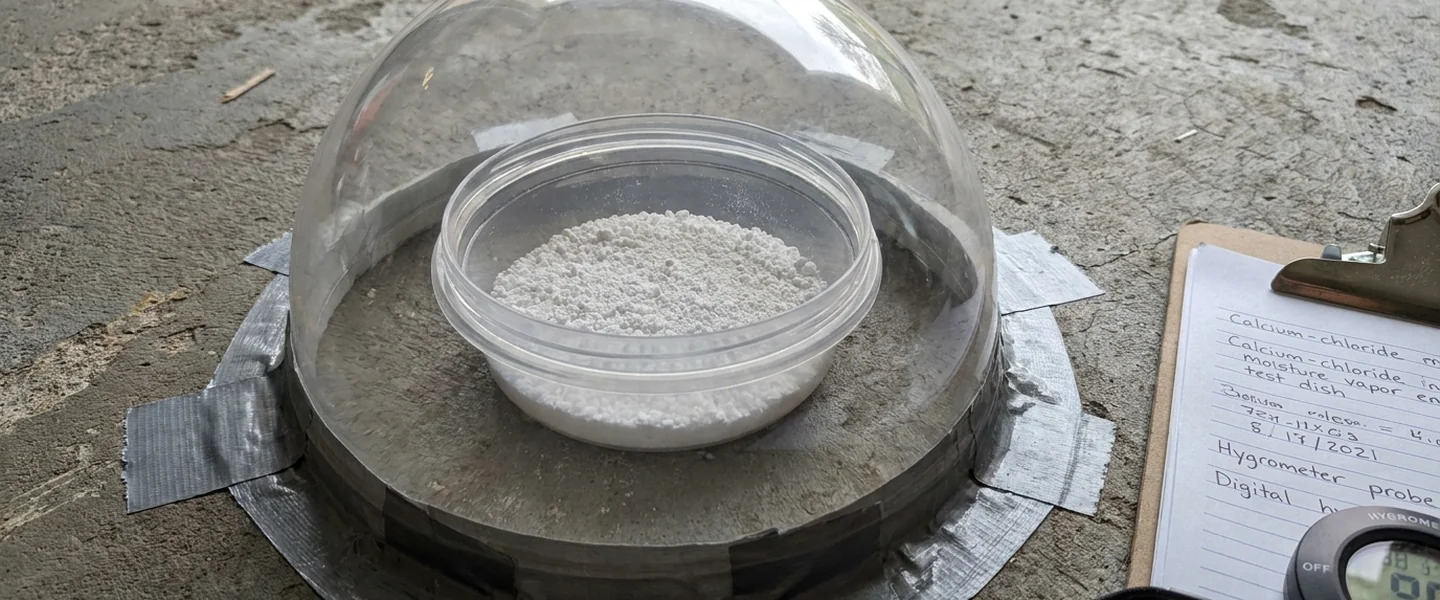
ASTM F1869 — Calcium Chloride Test. A dish containing a measured weight of anhydrous calcium chloride is sealed to the slab under a clear plastic dome for 60-72 hours. The weight gain of the calcium chloride is measured at the end of the test period and converted to pounds per thousand square feet per 24 hours. Cost: low. Time: 60-72 hours per test point. Suitable for: most Philadelphia-area residential garages and basements.
ASTM F2170 — In-Situ Relative Humidity Probe. A probe is inserted into a drilled hole in the slab to a depth of 40% of the slab thickness. After 72 hours of equilibration, the relative humidity inside the slab is read. This is the more accurate test, particularly for newly poured slabs, but it requires drilling. Cost: moderate. Time: 72 hours equilibration. Suitable for: high-value installs, basement installs, slabs where calcium chloride results are borderline.
What the Numbers Mean
| Calcium Chloride (lb/MSF/24hr) | What it means for coating |
|---|---|
| 0-3 | Low emission. Most coatings will perform without a vapor-block primer. |
| 3-7 | Moderate emission. Vapor-block primer recommended; many coatings will fail without it. |
| 7-12 | High emission. Heavy-duty vapor-block primer required. Many systems can’t handle this level even with a primer. |
| 12+ | Very high emission. Specialty primers required; some installs not advisable until source moisture is addressed. |
What a Vapor-Block Primer Is
A vapor-block primer is a two-component epoxy or polyurea primer formulated specifically to reduce or block moisture vapor transmission through the slab. It is applied at a higher mil thickness than a standard primer (typically 12-18 mils) and is designed to bond to a wet or moisture-emitting slab without lifting itself. Once cured, the vapor-block primer becomes the new substrate for the coating system. Common products: Sika MoistureGuard, ARDEX MC-RAPID, Mapei Primer SN, Westcoat MVP, and several PolyTek and Wolverine products specifically formulated for high-MVER slabs.
Philadelphia-Specific Patterns
In our experience across the Philadelphia metro:
Older row-home basements (pre-1940, common in Norristown, parts of South Philadelphia, Manayunk) typically test at 7-12+ lb/MSF/24hr and require heavy vapor-block primers. About 30% of these slabs are not good candidates for coating without source moisture remediation first.
Mid-century slab-on-grade garages (Levittown, parts of Bensalem, Cherry Hill) typically test at 3-7 lb/MSF/24hr. A standard vapor-block primer handles them.
Newer construction (post-1990 Doylestown, King of Prussia, Helena-style subdivisions) with proper under-slab vapor barriers typically test at 0-3 lb/MSF/24hr and don’t need a vapor-block primer for typical coatings.
Above-grade attached garages with a basement below typically test low for the slab itself, but the wall-floor cove joint can be a moisture-entry path that needs separate detailing.
What to Ask the Installer
- Do you test moisture vapor emission on every slab-on-grade or basement install?
- What test do you use — calcium chloride, in-situ probe, or both?
- What does the result drive in your scope and quote?
- What vapor-block primer do you use, and is it rated for the result you measured?
- What’s your warranty position if moisture vapor emission causes a failure later?
- Can you show me the test results from a previous Philadelphia-area job?
What Not to Do
Don’t accept a quote that doesn’t mention moisture testing on a slab-on-grade or basement install. The omission is a warning sign that the contractor is hoping for the best.
Don’t accept a vapor-block primer spec without the rated emission level. “Vapor-block primer” by itself is meaningless; the primer has to be rated for the emission rate that was actually measured.
Don’t try to coat over an obvious moisture problem (efflorescence, visible damp, prior coating blisters). Source moisture has to be addressed first or the new coating will fail the same way the prior one did.
Common Misconceptions About Moisture Vapor Emission
“My slab is dry. I checked.”
Surface dryness has nothing to do with vapor emission rate. A slab can be perfectly dry to the touch and still emit at 10+ lb/MSF/24hr. The test is the only way to know.
“It only matters for new slabs.”
Older slabs can have higher emission rates than new slabs because the under-slab moisture has had decades to migrate up. Age doesn’t protect against the failure mode.
“A thicker coating will stop the moisture.”
It will not. The thicker coating builds higher pressure before lifting. The right answer is a vapor-block primer that’s designed to handle the emission, not a thicker topcoat.
“My basement isn’t damp, so I’m fine.”
Damp surface and high emission rate are different things. A basement that feels dry can still be a poor coating candidate without testing.
Bottom Line
Moisture vapor emission is the silent killer of Philadelphia-area garage and basement coatings. The fix is straightforward: test, then spec the right primer for the result. The cost of the test is trivial compared to the cost of replacing a blistered coating two years after install. Call (267) 376-6921 for a free 30-minute inspection that includes moisture testing on slab-on-grade and basement installs, with a written quote that reflects the actual measured conditions of your slab.
Service Areas We Cover
We serve Philadelphia and the entire metro area on both sides of the Delaware River. Click your suburb for local details and the conditions we typically find in your housing stock:
Free Epoxy Floor Estimate in Philadelphia
Same-week appointments. No high-pressure sales. Serving Philadelphia and surrounding areas including Cherry Hill, King of Prussia, Conshohocken, Media, Bensalem, Doylestown, Levittown, Norristown.