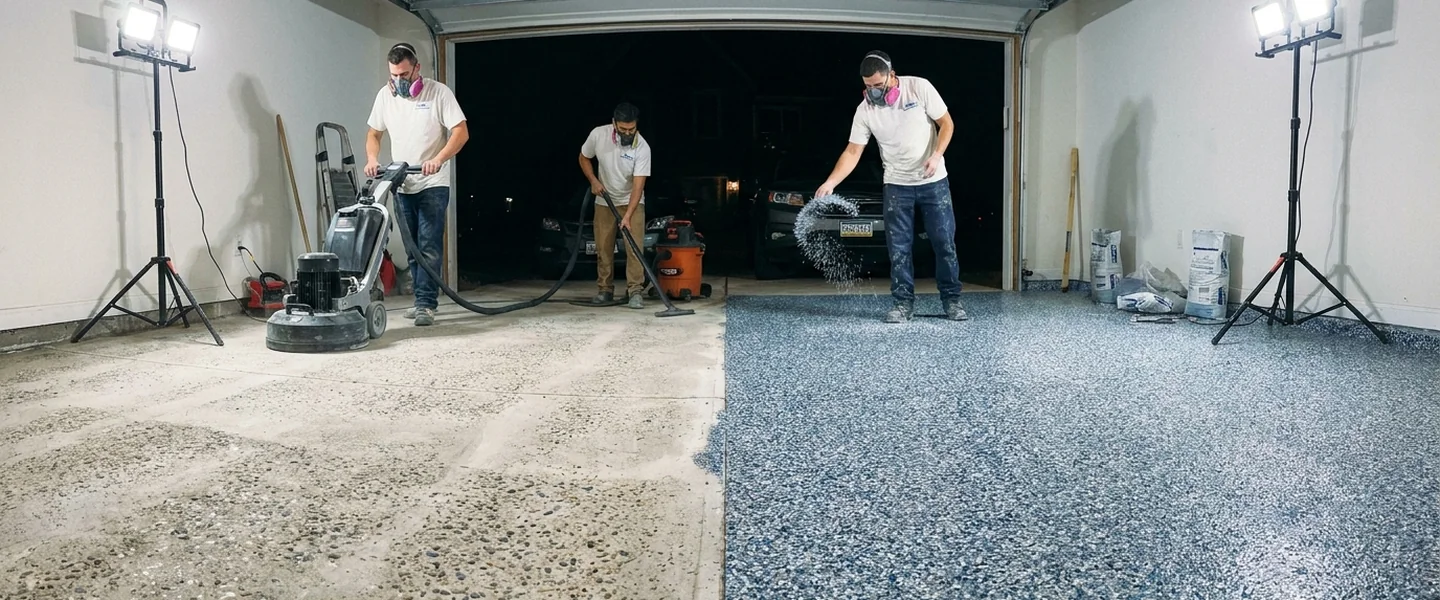
How Long Does an Epoxy Garage Floor Take to Install in Philadelphia?
Locally based epoxy floor specialists serving the Philadelphia metro since 2019.
- Licensed & Insured in Pennsylvania
- Locally Owned, Philadelphia-Based
- 15-Year Polyaspartic Topcoat Warranty
- Free On-Site Estimates
- 0% Financing Available
The most common question we get during inspection visits in the Philadelphia metro is “how long is the install going to take?” Homeowners want to plan around it — work-from-home schedules, parking arrangements, contractor sequencing if they have other work happening, gear and tool storage. The honest answer is that epoxy and polyaspartic floor install timelines depend on a few specific factors, but for the typical Philadelphia-area garage, the install runs 1-3 days from start to finish. This post explains exactly what happens each day and what affects the timeline up or down.
Day 0: The Inspection and Slab Prep Plan
Before install day, we visit the slab for 30 minutes. We take moisture readings, photograph existing conditions, identify any crack or repair scope, and write the install plan. This is not part of the on-site timeline but is essential to the day-by-day plan that follows.
Day 1: Slab Repair and Diamond Grinding
The crew arrives between 7:30 and 8:30 in the morning. They walk the garage with the homeowner one more time, photograph existing conditions for the install record, and confirm any special instructions. Then the demolition starts: any prior coating is stripped, any active cracks are routed and filled with polyurea, any divots or spalled areas are patched with epoxy mortar. Once the repairs have flashed, diamond grinding begins. The grinder runs over the entire slab to remove any remaining coating, contamination, or laitance and to expose the fresh aggregate paste. The slab is HEPA-vacuumed clean. Wall edges, posts, and control joints are detailed by hand. Hours on site: 6-10 typically depending on slab size and condition.
Day 2: Coating Install
Day 2 is the heart of the install. For a polyaspartic-only system, the entire coating goes on in a single day: pigmented or clear basecoat, optional flake broadcast, polyaspartic topcoat, and slip-resistance aggregate. For a hybrid epoxy-polyaspartic system, day 2 is the epoxy basecoat with broadcast flake; day 3 is the polyaspartic topcoat. Day 2 starts with a final inspection of the prepped slab, then materials are mixed in batches sized to the working time of the chemistry. The basecoat goes on by squeegee and back-roller; flake is broadcast to refusal while the basecoat is wet. Hours on site: 6-8 typically.
Day 3 (for hybrid systems): Topcoat and Detail
For epoxy-polyaspartic hybrid systems, day 3 is the topcoat day. The crew arrives, scrapes any loose flake from yesterday’s broadcast, HEPA-vacuums the slab, then rolls one or two coats of clear polyaspartic. The final coat carries the slip-resistance aggregate broadcast. Hours on site: 4-6 typically. By end of day 3 the coating is foot-traffic-ready; vehicle traffic is allowed at the manufacturer-specified return time (typically 24-48 hours after the final coat).
Day 4 (if needed): Concrete Repair or Custom Work
For garages with significant concrete repair scope (deep spalling, self-leveling underlayment requirements, extensive crack injection), day 4 may be needed. Self-leveling underlayment typically needs to cure 12-24 hours before it can be ground; on those jobs, day 1 is repair, day 2 is grind, days 3-4 are the coating system. Metallic epoxy installs sometimes take an extra day for the design pour and intermediate cure. Hours vary.
What Adds Days to the Timeline
Concrete repair scope. Active cracks, deep spalling, divot fill, or self-leveling underlayment can add a day. We schedule the repair on day 1 and let it flash before grinding.
Metallic epoxy or designer finish. The artistic basecoat pour, intermediate cure, and clear topcoat add a day vs. solid-color or flake systems.
Moisture testing and vapor-block primer. If we’re doing moisture testing in-situ, that adds 72 hours from the test setup to the result. Once the result is known, the install schedule continues with the appropriate primer.
Cold-weather installs. Philadelphia winter installs are routine but slow down when slab temperatures drop below 40°F. We schedule heated cure tents which keep the slab in the right working range; expect 1 extra hour per day of setup and breakdown.
Custom integration with adjacent surfaces. Garages with cove bases to adjacent rooms, custom trim integration, or coating extending into a workshop or basement area can add a day for the detail work.
What Doesn’t Add Days
Square footage alone usually doesn’t add days the way homeowners expect. The difference between a 400 sq ft single-bay and a 1,000 sq ft three-car bay is more crew-hours per day, not necessarily more days. A larger crew handles the larger scope in the same timeframe. We adjust crew size to keep the schedule predictable.
What to Plan Around the Install
You can live in the home throughout the install. The crew uses the garage door for material handling; HVAC continues to run normally. Noise: the loudest day is day 1 (grinding). Day 2 and day 3 are quieter. We work 7:30 to 4:30 typically and don’t run heavy equipment outside those hours. Kids and pets can be home — we ask that they stay out of the work area for safety and to avoid foot traffic on freshly coated surfaces.
Parking
You’ll need to park outside during the install and during the cure-to-vehicle-traffic period. For a polyaspartic-only system, that’s 24 hours after the final coat. For a hybrid epoxy-polyaspartic system, that’s 24-48 hours after the final coat. For a metallic epoxy system, that’s 48-72 hours. We give you the specific return time in the written quote so you can plan.
Storage
Garage contents need to be moved out before day 1. Most homeowners use a temporary canopy, a driveway pad, or a neighbor’s garage for the install week. Heavy items (workbench, motorcycles, large tools) can be staged on the driveway under a tarp. We’ll let you know if your storage plan creates any access issues for our equipment.
Weather
The garage interior is protected from precipitation. Cold weather affects cure speed (we use heated cure tents below 40°F slab temp). Rain or snow during install is generally not a problem — the work is interior. The Philadelphia winter season is fine for installs; we schedule heated cure tents as needed. The summer humid stretch (July-August) can extend the working window of epoxy slightly but doesn’t materially affect the timeline.
Why Some Companies Quote Longer Timelines
National franchises sometimes quote 4-5 day timelines for Philadelphia-area residential garage installs. The longer timeline is usually a function of crew scheduling (one crew handling multiple jobs simultaneously and not assigning a full crew to your job), not the actual scope. We typically run a dedicated crew on your job from start to finish, which keeps the timeline tight without sacrificing quality.
Common Misconceptions About Timeline
“Epoxy floors take a week.”
Almost never. A 1-3 day install is typical for a Philadelphia-area residential garage. Multi-week timelines indicate either heavy concrete repair scope (rare) or a contractor running multiple jobs simultaneously.
“The coating takes weeks to cure before you can park on it.”
For polyaspartic systems, vehicle return is 24 hours after the final coat. For hybrid systems, 24-48 hours. Full mechanical cure (where the coating reaches its lab-rated hardness) takes 7-14 days, but that’s not the same as walkable or drivable cure.
“I’ll see results in months.”
You’ll see results on day 1. The grind reveals what the slab actually looks like clean; the coating goes on within a day or two of the grind. Most homeowners say the floor looks better than they imagined on the morning of the final walkthrough.
Questions to Ask the Contractor About Timeline
- Will the same crew be on my job every day, or will they rotate?
- What’s the day-by-day breakdown of the install?
- What would extend the timeline, and how do you handle that?
- What hours will the crew be on site?
- How do you handle weather delays in the schedule?
- When can I park on the floor after the final coat?
Bottom Line
For the typical Philadelphia-area residential garage, plan on 1-3 days from start to finish. Concrete repair, metallic finishes, or extensive moisture remediation can extend that. We give you a day-by-day schedule with the written quote so you can plan around the install. Call (267) 376-6921 for a free 30-minute inspection and a written timeline within 24 hours.
Service Areas We Cover
We serve Philadelphia and the entire metro area on both sides of the Delaware River. Click your suburb for local details and the conditions we typically find in your housing stock:
Free Epoxy Floor Estimate in Philadelphia
Same-week appointments. No high-pressure sales. Serving Philadelphia and surrounding areas including Cherry Hill, King of Prussia, Conshohocken, Media, Bensalem, Doylestown, Levittown, Norristown.