Why Hot Tires Lift Epoxy (and How a Proper Topcoat Stops It)
Locally based epoxy floor specialists serving the Philadelphia metro since 2019.
- Licensed & Insured in Pennsylvania
- Locally Owned, Philadelphia-Based
- 15-Year Polyaspartic Topcoat Warranty
- Free On-Site Estimates
- 0% Financing Available
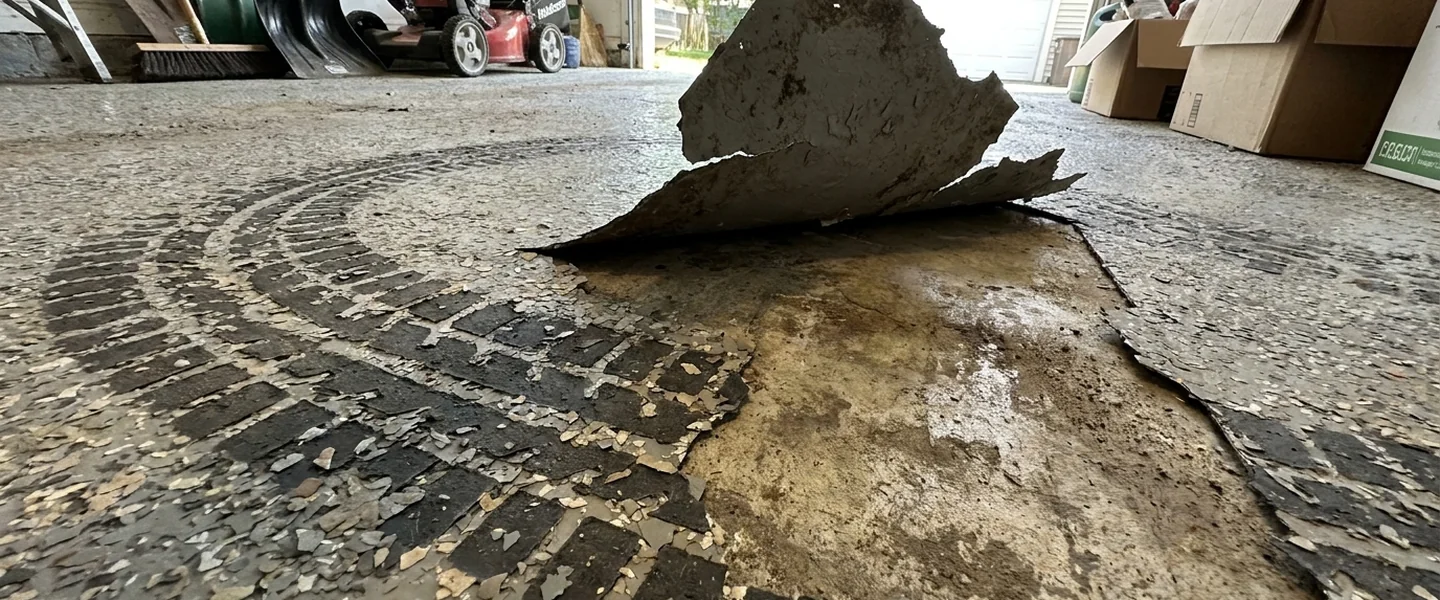
Of all the failure modes we get called to repair in the Philadelphia metro, hot-tire lift is the most preventable — and the most disappointing for homeowners who paid for a coating that should have lasted decades. A car comes home from an interstate run, the tires are at 150°F or higher, they sit on the slab overnight, and the next morning when the car backs out, the coating lifts off in patches that match the tire footprint. The cause is poorly understood and the fix is rarely explained well in marketing copy. Here’s what’s actually happening and how a properly engineered system prevents it.
What Hot-Tire Pickup Actually Is
Two physical mechanisms combine to cause the failure. First, a hot tire transfers heat to the coating below it; the polymer film softens slightly as it warms. Second, the rubber tire compound has a strong affinity for many polymer chemistries — particularly cheap epoxies and acrylic sealers — and when the rubber compound contacts the warm polymer film, a temporary bond forms between the tire and the coating. When the car moves the next morning, that bond can be stronger than the bond between the coating and the slab — and the coating lifts off.
Why It Happens More in Philadelphia
The Delaware Valley climate gives us hot summers (90°F+ ambient with slab temperatures reaching 100°F+) and a lot of interstate driving on I-95, I-76, I-476, and the PA Turnpike. Tires that have been on hot asphalt at highway speeds for an hour come home at 150-170°F. The combination of slab temperature plus tire temperature is the worst case for hot-tire pickup. Garages without ventilation or shade exposure are particularly vulnerable.
Why Cheap Epoxies Fail
Big-box-store DIY epoxy paint kits are water-based, thin (typically 3-5 mils), and use a plasticizer chemistry that softens significantly at elevated temperatures. They also rely on acid-etch prep that provides only mechanical bond — there’s no chemical bond between the polymer and the concrete. So you have a thin, soft, mechanically-bonded film and a hot rubber tire pressing into it. The lift is almost inevitable in our climate.
Why Single-Part Acrylic Sealers Fail
Some early-2000s contractor installs used single-part acrylic or oil-based concrete sealers as a budget topcoat. These have similar problems — soft polymer chemistry, low mil thickness, no chemical bond to the slab. They fail in tire-track patterns within 2-3 summers.
Why Properly Prepped Polyaspartic Doesn’t Lift
Three factors combine to make a polyaspartic-topcoated system immune to hot-tire pickup:
1. Diamond-ground concrete prep. The slab is ground to a CSP 2-3 profile, exposing the aggregate paste and opening the pore structure of the concrete. The epoxy or polyaspartic basecoat actually penetrates into the slab and chemically bonds to the cementitious matrix — not just mechanically interlocked with surface texture. This chemical bond is dramatically stronger than the bond between a hot tire and the coating film, so the tire wins zero contests for adhesion.
2. Thermal-stable polyaspartic topcoat. Polyaspartic chemistry is rated for thermal cycling from below freezing to well above 200°F. The polymer does not soften under tire contact and does not form a temporary bond with rubber compounds. The chemistry is fundamentally different from soft epoxies and acrylics in this respect.
3. Proper mil thickness. A residential garage system with epoxy basecoat plus polyaspartic topcoat ends up at 20-30 mils total film thickness — far more substrate to deal with than a 3-5 mil DIY paint kit. Even if some interaction happened at the surface, the coating mass is structural rather than a thin film.
The Three Tests for a Hot-Tire-Resistant System
If you’re talking to an installer about your Philadelphia-area garage and want to verify the system will resist hot-tire pickup, ask these three questions:
- Is the slab prepped by diamond grinding to CSP 2-3 profile? Anything less and the bond is mechanical only.
- Is the topcoat a true polyaspartic, rated for thermal cycling and chloride exposure? Ask for the brand and product code.
- What’s the total mil thickness of the finished system? Anything under 20 mils is suspect for our climate.
If Your Floor Has Already Lifted
Hot-tire lift is generally not repairable with a spot fix. The lifted area indicates the underlying system has a fundamental adhesion problem (usually acid-etch prep instead of diamond grind, sometimes a chemistry mismatch between basecoat and topcoat). Even if you patch the lifted area, the same failure will appear in adjacent tire-track zones over the next few summers. The honest answer is a full strip, regrind, and proper system install. We don’t enjoy delivering that message, but it’s the truth.
Garage Use Patterns That Make It Worse
Some homeowner habits accelerate the failure on a marginal system. Backing the car in immediately after a hot run (tires haven’t cooled) puts maximum heat on the slab for the longest time. Parking in the same spot every day concentrates the wear on the same patch of coating. Keeping the garage closed and unventilated traps heat. None of these are issues on a properly engineered system — but if you’re on a marginal system already, they accelerate the timeline to failure.
Philadelphia-Specific Considerations
Summer hot-tire risk in our metro is highest July through September. Interstate-commuter homes (close to I-95, I-76, I-476, PA Turnpike, the AC Expressway in South Jersey) see the highest tire temperatures. South-facing garage doors that are often open in summer also see elevated slab temperatures. Garages adjacent to dark-colored driveways pick up additional radiant heat. All of these factors argue for a properly engineered system rather than a budget install in our climate.
Common Misconceptions About Hot-Tire Pickup
“Hot-tire pickup is a fundamental epoxy problem.”
Not true. Properly prepped epoxy-polyaspartic and polyaspartic-only systems do not lift under hot tires. The failure is a prep-and-chemistry failure, not a fundamental coating limitation.
“Cooling the tires off in the driveway before parking prevents it.”
It reduces the risk on a marginal system but does not eliminate it. The right fix is a system that doesn’t lift, not a habit you have to maintain forever.
“Older garages are more prone to it.”
Slab age isn’t the issue — install quality is. A 1950s Levittown slab properly prepped with diamond grinding and coated with a thermal-stable polyaspartic topcoat will not lift. A 2020 estate slab with acid-etch prep and a cheap topcoat will lift in the first summer.
“You can just touch up the lifted patches.”
You can spot-patch in the short term but the underlying issue (failed prep or bad chemistry) will produce more lift in adjacent areas. The honest fix is a system rebuild.
What to Ask the Installer
- Does your prep include diamond grinding to CSP 2-3 profile?
- What polyaspartic topcoat brand and product code do you use?
- What’s the total finished mil thickness?
- Is the topcoat rated for chloride and thermal exposure?
- What’s your callback rate for hot-tire failures, and how do you handle them under warranty?
- Can you show me a Philadelphia-area job that’s at least 5 summers old, with photos?
Bottom Line
Hot-tire pickup is a preventable failure. The combination of diamond-ground prep, thermal-stable polyaspartic topcoat chemistry, and proper mil thickness eliminates it as a failure mode in Philadelphia-area garages. If you’ve experienced hot-tire lift on a previous coating and want a system that actually handles it, call (267) 376-6921 for a free inspection. We’ll walk the slab, explain what likely caused the original failure, and write a quote for a system that will not lift.
Service Areas We Cover
We serve Philadelphia and the entire metro area on both sides of the Delaware River. Click your suburb for local details and the conditions we typically find in your housing stock:
Free Epoxy Floor Estimate in Philadelphia
Same-week appointments. No high-pressure sales. Serving Philadelphia and surrounding areas including Cherry Hill, King of Prussia, Conshohocken, Media, Bensalem, Doylestown, Levittown, Norristown.