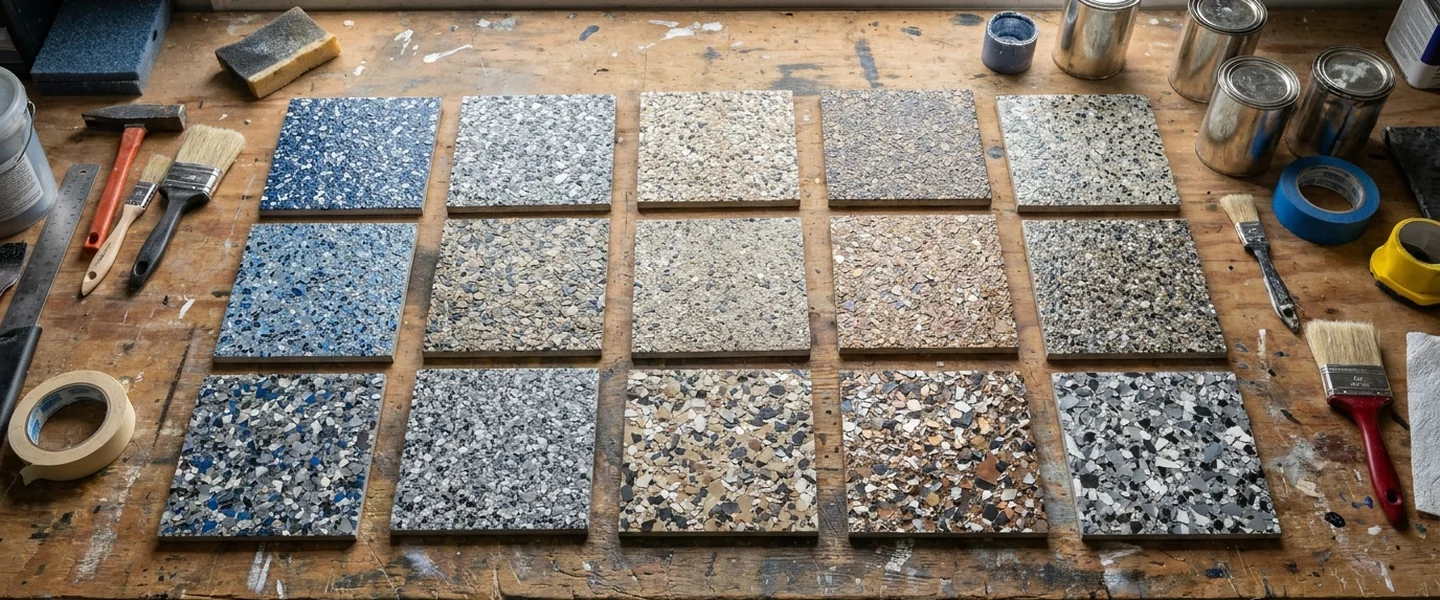
Garage Floor Flake Patterns: How to Pick the Right Look for Your Home
Locally based epoxy floor specialists serving the Philadelphia metro since 2019.
- Licensed & Insured in Pennsylvania
- Locally Owned, Philadelphia-Based
- 15-Year Polyaspartic Topcoat Warranty
- Free On-Site Estimates
- 0% Financing Available
One of the most-asked design questions during our Philadelphia-area garage floor inspections is “what flake pattern should I pick?” The vinyl flake (also called chip) broadcast on a residential garage system is more than decorative — it adds slip resistance, hides minor dirt and tire marks, and creates the visual identity of the finished floor. With dozens of color blends and broadcast densities available, the choice can feel paralyzing. This post walks through how to think about flake pattern selection for your specific home.
What Vinyl Flake Actually Is
Vinyl flake is small PVC color chips, manufactured in a wide range of color blends and sizes (1/16 inch, 1/8 inch, 1/4 inch, and 1 inch are most common). The flake is broadcast onto the wet epoxy or polyaspartic basecoat to refusal, meaning enough chip is thrown that the basecoat is completely covered. The next day, the loose unbonded flake is scraped off and vacuumed, leaving a textured surface that’s then locked under one or two coats of clear polyaspartic topcoat.
The Four Dimensions of Flake Selection
Every flake pattern decision comes down to four choices: color blend, chip size, broadcast density, and base color of the epoxy underneath.
1. Color Blend
Manufacturers like Torginol and Penntek offer hundreds of pre-blended color schemes — earth tones, gray-tones, deep blues, charcoals, custom team colors, and brand-matched blends. Each blend is a mix of typically 3-5 individual chip colors that combine to produce the finished look. Some blends are subtle (gray-on-gray); some are bold (cobalt and slate against white). Your installer should have physical sample boards on hand so you can see how each blend looks in real lighting, not just in a catalog image.
2. Chip Size
1/16 inch flake — Smallest standard size. Produces a fine, almost stippled appearance that reads as solid color from a distance. Most popular in residential basements and contemporary garage installs where the homeowner wants a clean finished look.
1/8 inch flake — Mid-size. The most common residential garage chip. Balances visual texture with practicality; hides tire marks and minor dirt well. Default recommendation for most Philadelphia-area garages.
1/4 inch flake — Larger. Visible as discrete chips at any viewing distance. Adds visual drama and is common in showroom garages, hobby spaces, and commercial bays.
1 inch flake — The largest standard. Bold, dramatic, almost decorative-tile in appearance. Best suited for spaces where the floor is part of the visual design intent — showroom floors, design-conscious basements, retail.
3. Broadcast Density
How much flake gets thrown onto the basecoat matters. Three densities are common:
Light broadcast (40-60% coverage): Flakes are visible as discrete chips with the base color showing through. Often used when the base color is part of the design intent.
Medium broadcast (70-85% coverage): Most flakes touching but some base color showing in gaps. Common in suburban residential garages.
Full broadcast to refusal (100% coverage): Flake is broadcast until the basecoat is completely covered. The most popular density in our installs because it provides the most consistent finish and the best slip resistance.
4. Base Color
The epoxy underneath the flake matters. A black base under a light flake blend creates contrast in any gaps; a matching base creates a continuous read. The choice depends on whether you want the basecoat to be visible at all or whether you want a pure flake surface.
How to Match Flake to Garage Use Case
The flake should match what the garage is actually used for. A few examples from our Philadelphia-area work:
Daily-driver-only garages typically pick a medium chip size (1/8 inch) in a mid-tone earth or gray blend, full broadcast. The goal is a floor that looks good but doesn’t show tire marks, dirt, salt residue, or minor spills.
Hobby and gym garages (King of Prussia, Doylestown estates) often pick a 1/4 inch chip in a bolder blend — slate-and-charcoal, navy-and-gray, custom team colors. The space doubles as a workshop or display area and the floor is part of the design.
Workshop garages with oil exposure and tool drops often pick a darker base with a darker flake blend to hide spills and tire marks. Slip resistance is heavier here too.
Showroom or display garages (auto enthusiasts, motorcycle collectors) often pick metallic epoxy instead of flake — but when they do choose flake, it’s typically 1/4 inch or 1 inch in a high-contrast palette.
Basement living-space conversions typically pick 1/16 inch fine flake in a subtle blend that reads as solid-color from a distance, often with a heavier slip-resistance aggregate added to the topcoat for safety.
What Flake Blend Works in Philadelphia
In our Delaware Valley work, the most popular blends are mid-tone gray-and-charcoal, earthen mix (browns and tans), and navy-and-slate. These hide road-salt residue, tire marks, and minor dirt better than light or pastel blends. Light blends (cream, white-on-tan) look gorgeous on day one but show salt residue immediately in our winter climate — most Philadelphia-area homeowners regret picking the lightest blends within one winter season. We’ll be honest with you if you’re pointing at a blend that won’t age well in our climate.
How Flake Affects Slip Resistance
Flake itself provides some slip resistance — the textured surface gives traction underfoot. But the primary slip-resistance contribution comes from the aggregate broadcast into the final topcoat (aluminum oxide, polymer bead, or silica). The flake size and density don’t substitute for proper aggregate in high-slip-risk applications. Most residential garages get a moderate aggregate broadcast; commercial and basement installs get heavier.
How Flake Affects Maintenance
A full-broadcast flake floor is one of the easiest residential floors to maintain. Sweep weekly, mop with a neutral cleaner, snow-melt residue rinses off in spring with a hose. The textured surface hides dirt between cleanings far better than a smooth solid-color coating. Pet claws don’t scratch the topcoat. Floor jacks roll smoothly on the textured surface. The flake doesn’t fade because it’s locked under a UV-stable polyaspartic topcoat.
What About Custom Patterns?
Beyond standard blends, custom work is possible:
Inlay logos and team colors: A team logo or family monogram can be installed in the basecoat, then flake broadcast around it. Some homeowners do small inlays at the entry; some do larger center-of-bay designs.
Color blocking: Multiple color blends in different zones of the garage — one blend in the work zone, another in the parking zone, with a clean transition line.
Border treatments: A perimeter band of one blend with the field in another — common in showroom installs.
These add cost and a day or two to the install timeline, but the visual effect can be striking.
Philadelphia-Specific Flake Considerations
The Philadelphia winter creates two design considerations that don’t apply in drier climates. First, road-salt residue is white-gray and stands out against very dark or very light flake blends — mid-tone blends hide it best. Second, the freeze-thaw cycling at the bay-door threshold means the coating system at that zone gets the most movement; we sometimes spec a slightly more durable broadcast at the threshold and a finer pattern in the back of the bay where movement is less.
How to Decide
The honest answer: look at physical sample boards in actual daylight, in your actual garage if possible. Manufacturer color cards do not represent how the blend will look on your slab under your lighting at your viewing angle. Most installers (us included) bring 5-10 sample boards to the inspection visit. Lay them on the slab in different positions; look at them from inside the garage and from the driveway. Pick the blend that looks right in both views.
Common Misconceptions About Flake
“More flake = better.”
Not necessarily. Full broadcast to refusal is the most popular density because it produces a consistent look and the most slip resistance, but lighter broadcasts can be intentional design choices when the base color is meant to show.
“The flake fades over time.”
It does not, because it’s locked under a UV-stable polyaspartic topcoat. The vinyl chip itself is colorfast for decades; the polyaspartic protects it from UV.
“Larger flake means cheaper labor.”
Not really. The labor is similar across sizes; the chip cost varies modestly. The size choice should be driven by aesthetics and use case, not by trying to save on materials.
“Custom blends are way more expensive.”
Standard manufacturer blends are usually best because they’re production-tested. Custom blends are possible but cost more in material lead time and don’t usually improve the finished look over a well-chosen standard blend.
Bottom Line
For most Philadelphia-area garages, a 1/8 inch flake in a mid-tone gray or earthen blend, full broadcast to refusal, with a moderate slip-resistance aggregate in the topcoat is the sweet spot — durable, easy to maintain, hides winter residue, and looks great for decades. But your garage is your garage, and the choice should fit your aesthetic and your use case. Call (267) 376-6921 to schedule a free 30-minute inspection where we’ll bring sample boards and walk through the options on your slab.
Service Areas We Cover
We serve Philadelphia and the entire metro area on both sides of the Delaware River. Click your suburb for local details and the conditions we typically find in your housing stock:
Free Epoxy Floor Estimate in Philadelphia
Same-week appointments. No high-pressure sales. Serving Philadelphia and surrounding areas including Cherry Hill, King of Prussia, Conshohocken, Media, Bensalem, Doylestown, Levittown, Norristown.